
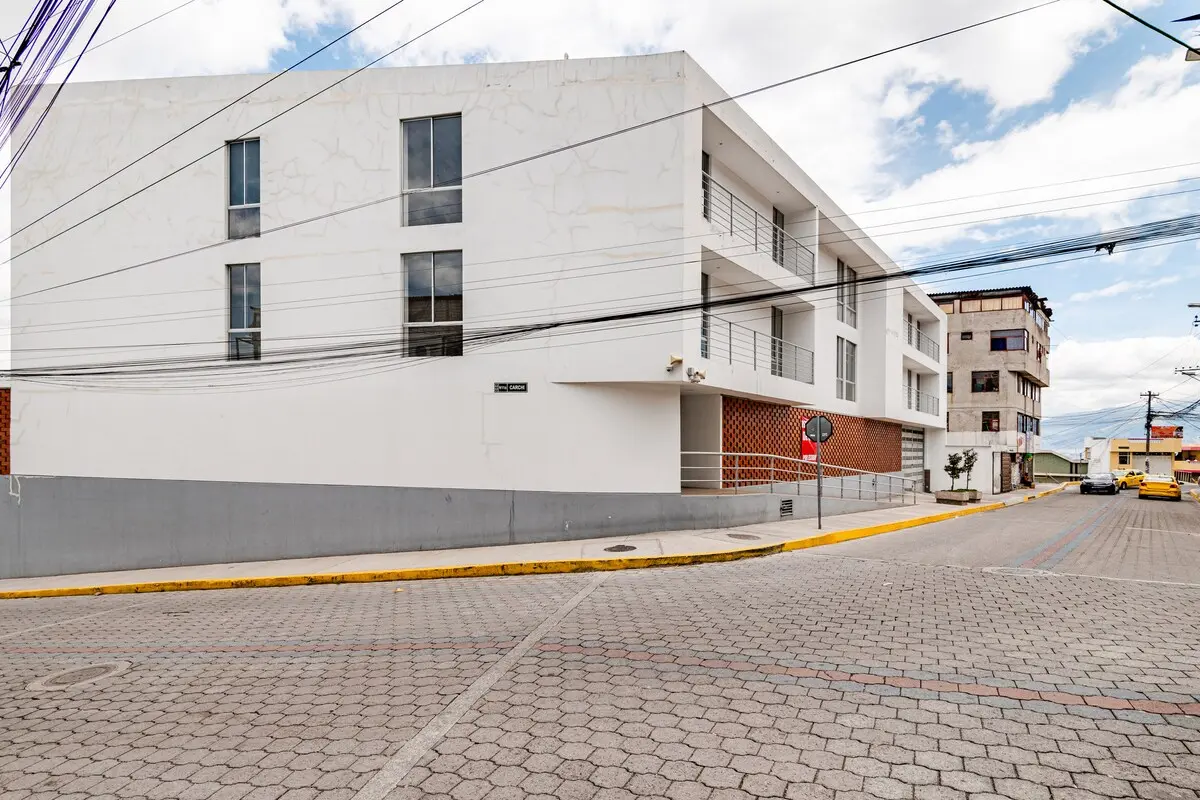
The short version: San Juan is a residential hillside neighborhood directly above Quito’s UNESCO Old Town, about a 12-minute walk downhill to Plaza Grande. It is safe to explore by day with normal big-city awareness; after dark, take a $2–3 Uber like the locals do. It suits couples, solo travelers and climbers acclimatizing at 2,850 m, and it is where our apartment, Perla de la Montaña, sits.
Most guides to Quito send you to the Old Town or to La Mariscal. San Juan is the hillside above the Old Town: close enough to walk down to the colonial churches in ten minutes, high enough that the whole historic center unfolds beneath your balcony. It is one of the city’s oldest neighborhoods, and it is where ordinary Quiteños actually live. Here is what it is really like to stay here.
Where San Juan is
San Juan climbs the eastern slopes of the Pichincha volcano, along the western edge of Quito’s UNESCO-listed historic center. Locals have long called it El Balcón Quiteño and “the eternal mirador”: from up here the Old Town spreads out below by day and turns into a carpet of lights at night, and on clear mornings you can pick out the snow cones of Cotopaxi, Antisana and Cayambe on the horizon.
The neighborhood’s best-known landmark is one you have almost certainly seen in photos of Quito: the neo-Gothic Basílica del Voto Nacional stands right here in San Juan, on Carchi street, which is why locals also call it “la Basílica de San Juan.” It is famous for gargoyles shaped as Ecuadorian and Galápagos animals (tortoises, iguanas, blue-footed boobies). In other words, the church most visitors take a taxi to reach is a few minutes’ walk downhill from a San Juan address. Nearby you will also find the peaceful Convento de San Juan Evangelista, the Augustinian monastery that gave the neighborhood its name, and the Mirador de San Juan viewpoint (measured at 2,887 m), a favorite local spot to watch the city.
Is San Juan safe?
This is the question every guest really wants answered, so here is what to expect. By day, San Juan and the historic center are fine to explore with the same common sense you would use in any big-city center. There is a regular police presence around the main plazas and churches. Pickpocketing and bag-snatching in crowds is the main risk, so keep your phone away when you are not using it, don’t flash valuables, and check maps inside a café instead of on a busy pavement.
After dark it changes. The Old Town empties out fast once the shops close, the cobbled streets get quiet and poorly lit, and the local advice is simple (it is the same advice you will read from Quito hotels and travel writers): don’t walk it at night. Going out for dinner or coming back in the evening, take an Uber or Cabify. A ride across the center costs about $2–3 and removes the only real risk. Do not hail a taxi off the street at night; use the apps, where you can check the plate and driver before getting in.
For context: the US State Department rates Ecuador as Level 2 (“exercise increased caution”), and Quito and Pichincha province are not in the higher-risk Level 3/4 categories that apply to parts of the coast. The UK’s FCDO flags mugging and pickpocketing in the Old Town and at transport hubs, and advises against walking alone in quiet areas at night, which is exactly why our guests default to app rides after dark. (Advisories change; check the latest before you travel.) One specific tip echoed everywhere: to visit El Panecillo, the hill with the winged Virgin of Quito, take a taxi up instead of walking the stairs.
Getting around from San Juan
Because you are on a hillside, the golden rule is easy going down, steep coming back up, and at 2,850 m that climb is real until you have acclimatized. Several of our guests love the walk down and simply grab a cheap taxi back.
- On foot: the Basílica is minutes away, and from our door it is about a 12-minute walk downhill to Plaza Grande, the main colonial square, and on to San Francisco and La Ronda.
- Ride-hailing: Uber, InDrive, DiDi and Cabify all operate here. Fares start around $1.50–2; Basílica to Plaza Grande is $2–3, and the Old Town to the TelefériQo cable car is roughly $3–4 (about a 15-minute drive).
- Public transport: Quito’s Metro Line 1 ($0.45) and the Trolebús/Ecovía bus corridors ($0.25) run close by. The nearest Metro stops for the San Juan side are La Alameda and San Francisco.
- From the airport: Mariscal Sucre (UIO) is about 40–45 km away, a 45–60 minute drive; a taxi is roughly $25–30, Uber $20–30. If you would rather be met, we arrange a door-to-door pickup for $35.
What’s within reach
Staying in San Juan puts the best of colonial Quito on your doorstep, most of it downhill.
Start with the Basílica del Voto Nacional, the nearest of the big sights: roughly 17,300 Google reviews, 8–10 minutes downhill from our door. It is also the reason you can hardly get lost here. The towers stand above every rooftop in San Juan, so when you lose your bearings in the Old Town, look up and walk toward them; the apartment is a few streets above.
The tower climb is the part guests mention afterward: a wooden walkway, then steep ladders up to a 360° view across the whole historic center. Save it for day two rather than straight off the plane, and plan the way home realistically. The 8–10 minutes downhill turn into a slow climb on the way back at 2,850 m.
The other sight this close gets a fraction of the Basílica’s visitors. The Centro de Arte Contemporáneo, about a 9-minute walk and the same 0.7 km from our door as the Basílica, shows changing exhibitions in a restored historic building. Entry was free at the time of writing. It has around 3,900 Google reviews to the Basílica’s 17,300 and is often quiet on weekdays. When guests want an indoor stop without the crowds, this is our answer.
- Plaza Grande, the Compañía de Jesús (the dazzling gold-leaf church) and Plaza San Francisco: the colonial heart, all within a short walk of each other.
- La Ronda: the pretty cobbled lane of artisans and cafés that comes alive in the evening.
- El Panecillo and the aluminium Virgin of Quito, with a viewing platform inside (take a taxi up).
- Markets & food: the everyday Mercado San Juan for fruit and provisions, and the larger Mercado Central down in the Old Town for a proper cheap almuerzo (soup, main and juice for a couple of dollars). San Juan itself is known among Quiteños for its motes y quesadillas, a bakery tradition going back generations.
Guests kept asking for exact numbers, so here they are. The distances below are straight-line measurements from our door, so the street route can add a little. The walking minutes cover the way there, mostly downhill toward the Old Town; for El Panecillo and the TelefériQo the table shows taxi minutes instead. Coming back up takes noticeably longer at 2,850 m, so many of our guests walk down and take a $2–3 taxi home.
| Place | Distance | Time |
|---|---|---|
| Basílica del Voto Nacional | ~0.7 km | ~8 min walk |
| Centro de Arte Contemporáneo | ~0.7 km | ~9 min walk |
| Plaza de la Independencia (Plaza Grande) | ~0.8 km | ~12 min walk |
| Iglesia y Convento de San Francisco | ~0.9 km | ~14 min walk |
| Mercado Central | ~1.1 km | ~14 min walk |
| Parque La Alameda | ~1.2 km | ~15 min walk |
| Mercado San Roque | ~1.2 km | ~16 min walk |
| Parque El Ejido | ~1.4 km | ~18 min walk |
| Cumandá Parque Urbano | ~1.8 km | ~22 min walk |
| Parque Itchimbía (giant letters) | ~1.9 km | ~35 min walk |
| El Panecillo / Virgen de Quito | ~1.9 km | ~10 min taxi |
| Casa de la Cultura Ecuatoriana | ~2 km | ~25 min walk |
| Mercado Artesanal La Mariscal | ~2.1 km | ~26 min walk |
| Mercado Santa Clara | ~2.1 km | ~26 min walk |
| TelefériQo | ~2.4 km | ~15 min taxi |
A word on altitude
Quito is the second-highest capital in the world at around 2,850 m, and San Juan is a touch higher again. Most visitors feel it mildly on arrival: a little breathlessness on the stairs, maybe a light headache. Take the first day or two gently, drink plenty of water, and hold off on alcohol at first. The upside is that a couple of easy nights up here make San Juan an excellent first sleeping altitude before Cotopaxi, Rucu Pichincha or the Avenue of the Volcanoes, which is exactly why some of our guests are climbers using Quito to acclimatize. Our full Quito altitude guide has a day-by-day plan.
Who San Juan suits
San Juan is for travelers who want the real, residential Quito with the Old Town at their feet. It is a lived-in Quiteño neighborhood with the views to match. It suits couples and solo travelers after character and everyday local life, Old Town and culture visitors who want to walk to the colonial sights, and hikers using the city as an acclimatization base. If wall-to-wall bars and restaurants at street level are what you are after, La Mariscal is the livelier choice. For most of our guests, though, trading a short evening taxi for safety and that balcony view is an easy call.
Frequently asked questions
Is San Juan a safe neighborhood in Quito?
By day, San Juan and the adjoining historic center are fine to walk with the usual city-center caution: keep your phone and valuables discreet, as pickpocketing is the main risk in crowds. After dark the Old Town empties out quickly, so locals and visitors alike take a short Uber or Cabify instead of walking. The US State Department rates Ecuador Level 2 overall, and Quito (Pichincha province) is not in the higher-risk categories that apply to some coastal areas.
Can you walk from San Juan to the Old Town?
Yes. The Basílica del Voto Nacional actually stands in San Juan, and Plaza Grande is about a 12-minute walk downhill from our door, past the Basílica. The catch our guests mention: it is easy going down and steep coming back up at 2,850 m. A taxi back costs only about $2–3.
How high is San Juan and do I need to acclimatize?
San Juan sits around 2,850–2,890 m above sea level (the San Juan viewpoint is measured at 2,887 m). Most people feel Quito’s altitude a little on arrival. Take the first day or two slowly, drink plenty of water, and go easy on alcohol at first. It makes Quito an ideal first sleeping altitude before Cotopaxi, Pichincha or the Avenue of the Volcanoes.
Is Uber available in San Juan, Quito?
Yes. Uber, InDrive, DiDi and Cabify all work in Quito, with fares starting around $1.50–2. Short hops around the Old Town are cheap; the Old Town to the TelefériQo cable car runs roughly $3–4. Use the apps instead of hailing a taxi on the street, especially at night.
How far is Quito airport from San Juan?
Mariscal Sucre International Airport (UIO) is about 40–45 km east of the city, a 45–60 minute drive (longer in rush hour). A taxi is roughly $25–30 and Uber $20–30. We also offer a door-to-door airport pickup for $35 if you would rather be met on arrival.
Is San Juan a good area to stay in Quito?
It is if you want a residential base among Quiteños while staying within walking distance of the UNESCO Old Town and the Basílica. It suits couples, solo travelers, and hikers using Quito to acclimatize. If your priority is nightlife you would look at La Mariscal instead; San Juan is about views, location and everyday local life.
What is within walking distance in San Juan, Quito?
The Basílica del Voto Nacional is 8–10 minutes downhill from our door, the Centro de Arte Contemporáneo about 9 minutes, Plaza Grande about 12 minutes, Mercado Central about 14 minutes, and Parque La Alameda about 15 minutes. The giant letters photo spot at Parque Itchimbía is 30–40 minutes on foot because the last stretch climbs, or a 5–10 minute taxi. El Panecillo is a taxi ride of about 10–15 minutes and the TelefériQo about 15 minutes by taxi. The Old Town walking times are one way going downhill; the climb back up is slower at 2,850 m, and a taxi home costs about $2–3.